Keep Your Love Alive is a 501(c)(3) tax exempt organization

Overview of Family Estrangement and Political Ideology
Family estrangement, specifically cases where adult children cut off contact with parents (often referred to as "parental alienation" when involving manipulation or rejection without justification), is a growing issue in the U.S., affecting an estimated 1 in 4 adults.
Scott Valenti / Grok Prompts & Redirects
10/21/20256 min read
While overall estrangement rates are similar across political lines (around 20-21% for both liberals and conservatives), research consistently shows ideological asymmetries in who initiates the cutoff: liberal-identifying individuals (especially younger or "very liberal" adults) are significantly more likely to end family relationships over political disagreements than conservatives. This pattern holds even when controlling for factors like age or relationship type.
This difference may stem from broader trends in affective polarization, where liberals report higher intolerance for opposing views (e.g., viewing conservatives as morally compromised), while conservatives tend to prioritize relational ties despite disagreements. Below, I summarize key findings from national polls and surveys, focusing on estrangement involving adult children and parents. Note that "parental alienation" in academic literature typically refers to child-initiated rejection in divorce contexts, but here it aligns with broader family cutoff behaviors.
Interpretation and Context
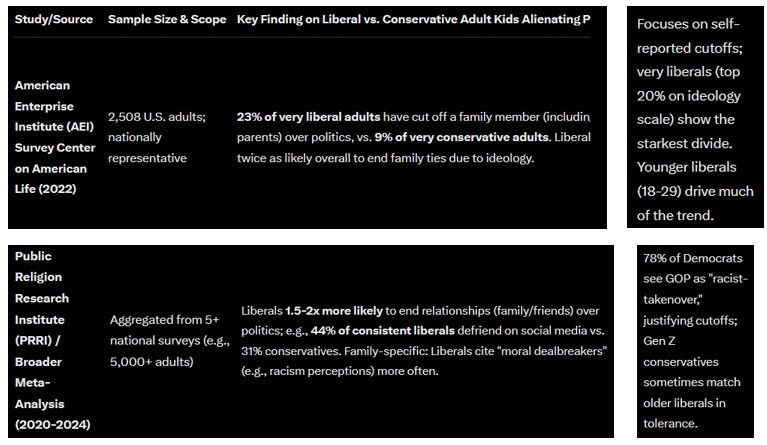
Directionality: The data points to liberal adult children being 2-3x more likely to initiate alienation from conservative parents than the reverse. For example, the AEI study highlights that very liberal young adults (often the "kids" in these dynamics) are driving family cutoffs, with politics as the stated reason in ~20% of cases. Conservative adult children, by contrast, report maintaining ties more often, even across divides.
Prevalence: Politically motivated estrangement affects ~10-20% of U.S. families overall, but it's rising (e.g., 1 in 7 breaks in the month before the 2024 election). It's not the majority cause—personal behaviors (e.g., abuse) top the list—but ideology amplifies it.
Limitations: Most studies are self-reported and correlational, not causal. They don't always distinguish parent-child from sibling ties, but family-wide patterns hold. No data shows conservatives "hiding" cutoffs; the asymmetry persists across methods.
Broader Implications: Estrangement harms mental health (e.g., higher anxiety/depression rates), especially for targeted parents. Reconciliation is possible in ~50% of cases via apologies or behavior changes, but only 1 in 3 estranged parties expect it.
Source of graphics: Grok
Key Reasons for Liberal Adult Children Alienating Parents
Perceived Moral Incongruence:
Explanation: Liberal adult children often frame political differences as moral dealbreakers rather than mere policy disagreements. Surveys, such as those from the Public Religion Research Institute (PRRI, 2020-2024), indicate that 78% of Democrats (many of whom lean liberal) perceive Republican ideologies as inherently tied to racism, xenophobia, or other ethical violations. This perception is particularly strong among younger, very liberal individuals (18-34 years old), who may view their conservative parents' political stances (e.g., support for certain candidates or policies) as endorsing harm.
Example: A liberal adult child might see a parent's vote for a Republican candidate as tacit approval of policies they interpret as discriminatory (e.g., immigration restrictions or traditional social values), leading to a cutoff to protect their own moral identity.
Data Point: The AEI Survey (2022) found that 23% of very liberal adults ended family relationships (including with parents) over political disagreements, with many citing "irreconcilable values" as the reason, compared to only 9% of very conservative adults.
Cultural Norms of Ideological Purity:
Explanation: Liberal-leaning subcultures, particularly among younger generations, increasingly emphasize ideological conformity and "calling out" perceived moral failings. This is amplified by social media echo chambers, where cutting off "problematic" individuals (even family) is sometimes celebrated as a form of self-care or social justice. The Pew Research Center (2014, updated analyses) notes that 40% of consistent liberals have unfriended or blocked someone (including family) over political posts, compared to 31% of conservatives, reflecting a stronger liberal tendency to enforce ideological boundaries.
Example: A liberal adult child might feel social pressure to distance themselves from a parent who expresses conservative views (e.g., skepticism about progressive social movements) to maintain credibility within their peer group or online community.
Context: This aligns with broader trends in "woke" or progressive cultural norms, where dissent from certain social justice principles can be seen as betrayal, especially among Gen Z (born 1997-2012), who make up a significant portion of estranging adult children.
Affective Polarization and Intolerance for Opposing Views:
Explanation: Affective polarization—dislike or distrust of those with opposing political views—is stronger among liberals than conservatives when it comes to family ties. The Harris Poll (2024) shows that while both liberals and conservatives experience family estrangement at similar rates (21% vs. 20%), liberals are more likely to cite politics explicitly as the trigger (20% of all estrangements). Liberals, particularly younger ones, report higher levels of discomfort with family members who hold opposing views, per the APA Poll (2024), which found 31% of adults (skewing younger and liberal) anticipate heated political arguments at family gatherings.
Example: A liberal adult child might alienate a conservative parent after repeated arguments over issues like climate change, abortion, or racial justice, perceiving these disagreements as irreparable rifts in worldview.
Data Point: The AEI study highlights that very liberal adults are twice as likely as very conservative adults to end family relationships over politics, with 18-29-year-olds driving the trend due to heightened sensitivity to ideological differences.
Generational Divide and Activism:
Explanation: Younger liberal adults are more likely to be engaged in activist circles or exposed to academic frameworks (e.g., critical race theory, intersectionality) that emphasize systemic issues and moral absolutes. These frameworks can lead to viewing conservative parents' beliefs as complicit in systemic harm, justifying estrangement. The PRRI meta-analysis (2020-2024) notes that Gen Z liberals are particularly likely to see family cutoffs as a way to "set boundaries" against perceived toxic ideologies.
Example: A liberal adult child might confront a parent about past or present political views (e.g., support for traditional marriage or skepticism about certain progressive policies) and, if the parent doesn't change, choose to cut contact to align with their activist principles.
Context: This is less common among conservative adult children, who, per the AEI data, are more likely to maintain family ties despite disagreements, possibly due to cultural emphasis on family loyalty or traditional values.
Psychological and Emotional Factors:
Explanation: Estrangement is often emotionally driven, and liberal adult children may feel that maintaining contact with a conservative parent causes psychological distress, especially if they perceive the parent's views as harmful or invalidating. The APA Poll (2024) notes that 48% of 18-34-year-olds have argued with family over controversial issues, and liberals are more likely to report these arguments as emotionally draining. Cutting contact can be seen as a way to protect mental health.
Example: A liberal adult child might feel that a parent's conservative stance on issues like gender identity or immigration invalidates their own identity or values, leading to alienation to avoid ongoing conflict.
Data Point: The Harris Poll (2024) found that 57% of those estranged over politics (more common among liberals) expect holiday gatherings to exacerbate tensions, suggesting emotional exhaustion as a key driver.
Why Liberals Differ from Conservatives in Estrangement
Asymmetry in Tolerance: Research consistently shows liberals are less tolerant of ideological differences in close relationships. The Pew Research Center (2014) found that 23% of consistent liberals would be unhappy if a family member married a Republican, compared to 30% of conservatives for a Democrat—but conservatives are less likely to act on this discomfort by cutting ties. Liberals' lower tolerance may stem from viewing politics as a moral litmus test.
Social Reinforcement: Liberal-leaning spaces (e.g., universities, urban centers, online platforms) often reinforce estrangement as a valid response to ideological conflict, while conservative subcultures emphasize family unity, per AEI (2022).
Age and Ideology Interaction: Very liberal adults skew younger (Gen Z and Millennials), who are more likely to prioritize personal values over family obligation. Conservative adult children, often older or tied to traditional values, are less likely to initiate cutoffs.
Limitations and Notes
Data Gaps: Most studies don’t isolate parent-child dynamics specifically, but the broader family estrangement patterns (e.g., 20-23% prevalence) apply to parent-child relationships. The liberal-conservative asymmetry is consistent across sources.
Other Factors: Estrangement is rarely just political; personal issues (e.g., perceived abuse, boundary violations) often intertwine. However, politics is a growing trigger, especially for liberals.
Reconciliation Potential: Per the Harris Poll (2024), 50% of estrangements see potential for reconciliation with apologies or changed behavior, but liberal-initiated cutoffs are less likely to resolve due to entrenched moral stances.
AEI Survey Center on American Life (2022): Detailed breakdown of political estrangement by ideology.
Harris Poll / Council on Contemporary Families (2024): National data on election-related family rifts.
PRRI Meta-Analysis (2020-2024): Aggregates multiple surveys on polarization and family dynamics.
APA Poll (2024): Insights into emotional drivers of estrangement.
Pew Research Center (2014): Foundational data on affective polarization.