Keep Your Love Alive is a 501(c)(3) tax exempt organization

The Silent Fracture: Understanding Family Estrangement in Modern Society
Family estrangement... the deliberate reduction or cessation of contact between relatives... has long been a hidden undercurrent in human relationships, but recent data reveals its growing visibility and impact.
Sourced through multiple articles and a.i. prompts
12/2/20254 min read
Far from a rare anomaly, estrangement touches millions, often leaving behind a trail of unresolved grief, stigma, and isolation. Drawing from national surveys, psychological research, and sociological studies, this article explores the diverse forms estrangement takes, the individuals and groups it disproportionately burdens, its generational patterns, and the underlying causes rooted in evolving family dynamics and societal shifts. While estrangement can be a necessary act of self-preservation, it also underscores the fragility of familial bonds in an era of heightened individualism and mental health awareness.
Types of Family Estrangement: Beyond the Parent-Child Divide
Estrangement isn't a monolith; it manifests in varied relational contexts, each with unique emotional and social ramifications. At its core, it involves a prolonged lack of communication or emotional connection, often triggered by unresolved conflicts.
Researchers categorize it by the familial roles involved, highlighting how proximity, shared history, and expectations shape the rupture.
Parent-Adult Child Estrangement: The most studied form, this occurs when an adult child distances themselves from one or both parents. It can be partial (e.g., infrequent contact) or total "no-contact," often stemming from perceived toxicity or unmet needs. Studies show this is the most common type, affecting about 10-11% of parent-child pairs.
Fathers are more frequently estranged than mothers, with adult children citing emotional unavailability or abuse.
Sibling Estrangement: Less visible but equally painful, this involves brothers, sisters, or stepsiblings cutting ties, often over competition, favoritism, or caregiving disputes. Data from a 2015 UK survey indicates that 30% of estrangements involve siblings, with many tracing back to childhood bullying or parental partiality.
Unlike parent-child rifts, sibling estrangement can ripple outward, straining other family ties.
Grandparent-Grandchild Estrangement: Often a byproduct of parent-child conflicts, this affects about 5% of families, per a 2022 YouGov poll. Grandparents may feel sidelined by in-law interference or evolving family norms, leading to indirect cutoffs.
Extended Family Estrangement: This encompasses aunts, uncles, cousins, or in-laws, where third-party influences (e.g., a new spouse) exacerbate divides. It's less documented but contributes to broader family marginalization, where individuals feel like the "black sheep."
These types aren't mutually exclusive; estrangements often cascade, turning one rift into a network of silences. A 2023 study notes that 68% of those estranged from a parent also experience sibling fallout.
Who It Affects Most: Demographics of Disconnection
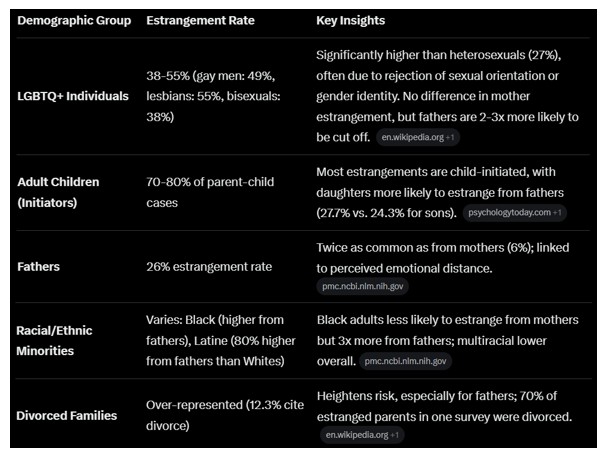
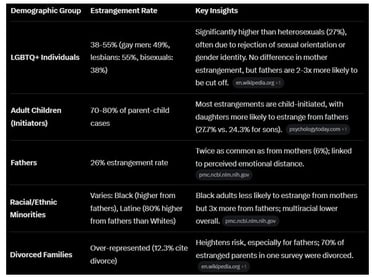
Estrangement doesn't strike uniformly; certain groups bear a heavier load, reflecting intersecting vulnerabilities like identity, socioeconomic status, and family history. National data paints a picture of disproportionate impact, with over 67 million Americans, about 27% of adults, reporting at least one estranged relative.
These patterns reveal how estrangement amplifies existing inequalities. For instance, LGBTQ+ individuals face higher rates due to familial non-acceptance, while divorced families see compounded instability.
The rejected party—often parents—experiences profound grief, akin to a "living loss," with physical health declines noted in 2023 research.
Generations in the Crosshairs: A Rising Tide Among the Young
Estrangement's generational footprint shows a stark skew toward younger cohorts, with Millennials (born 1981-1996) and Gen Z (born 1997-2012) at the forefront. A 2023 Cornell study estimates 27% of Americans over 18 are estranged, but rates climb to 30-40% among those under 45, driven by digital-age individualism and mental health prioritization.
The average age of first estrangement is 23-26, often in the mid-20s during identity formation or life transitions.
Younger generations initiate 70-80% of parent-child estrangements, viewing cutoffs as empowerment rather than failure—a shift from prior eras' "duty-bound" ties.
Social media amplifies this: TikTok's #NoContactFamily has millions of views, normalizing boundaries for Gen Z amid rising anxiety (30-year highs).
Baby Boomers (born 1946-1964), as parents, report 11% estrangement from children, often blindsided by these changes.
Intergenerational transmission exacerbates this: 65% of the estranged in one survey had family histories of cutoffs, modeling disconnection across generations.
Yet, reconciliation is possible—29% of estrangements end, per longitudinal data, though younger initiators are less likely to reconcile due to entrenched values.
Root Causes: Unraveling the Threads of Family Breakdown
Research pinpoints multifaceted causes, blending personal histories with cultural evolution. A 2015 study of 898 estranged pairs found adult children most often cite harm (e.g., abuse), while parents blame externals like spouses—highlighting perceptual gaps.
Key drivers include:
Abuse and Trauma (40-50% of cases): Emotional, physical, or sexual abuse tops lists, with 2023 data showing it as the primary initiator for adult children.
Unaddressed mental illness or substance abuse affects 20-30%.
Value Clashes and Identity Conflicts (25-35%): Disagreements over politics, religion, or identity (e.g., LGBTQ+ acceptance) fuel 30% of rifts, per YouGov.
A 2015 analysis links value dissimilarity to 3x higher odds of mother-child estrangement.
Family Structure Disruptions (15-20%): Divorce (12.3% cited) and in-law interference weaken bonds, especially for fathers.
Caregiving disputes cause 20% of sibling breaks.
Societal Shifts: "Concept creep"—expanding definitions of "abuse"—and individualism enable boundaries, but stigma persists (68% feel shame).
Pillemer's 2020 survey ties 27% prevalence to weakened kin ties from mobility.
These causes often intersect, with childhood favoritism (e.g., last-born bias) predicting later rifts.
Healing requires empathy, not defensiveness—79% never reconcile without mutual understanding.
Navigating the Aftermath: Toward Understanding and RepairFamily estrangement, while increasingly common, remains a profound "living loss," evoking grief without closure.
It disproportionately scars younger, marginalized groups, yet offers a lens into how families adapt—or fracture—under modern pressures. Data urges destigmatization: therapy, boundary-setting, and intergenerational dialogue can foster reconciliation in 29% of cases.
As society grapples with these fractures, recognizing estrangement as a symptom of deeper relational evolutions may pave the way for healthier kinships.
Resources and References
All data and insights are drawn from peer-reviewed studies, surveys, and expert analyses. Key sources include:
Wikipedia: Family Estrangement (2025 update).
Psychology Today: Various articles on estrangement causes and stats (2023-2024).
PMC/NIH: Parent-Adult Child Estrangement by Gender, Race/Ethnicity, and Sexuality (2023).
The Atlantic: A Shift in American Family Values (2021).
YouGov Poll: Family Ties and Estrangement (2022).
Stand Alone: Hidden Voices Report (2015) and Prevalence Study.
Cornell University: Fault Lines Survey (2019-2020).
Vogue: Why So Many Are Experiencing Estrangement (2024).
The New York Times: The Causes of Estrangement (2020).
PMC: Estrangement Between Mothers and Adult Children (2015).
Additional: Becca Bland's Living Loss (2023); Intent Clinical on Gen Z/Millennials (2023); The Week on No-Contact Trend (2024).